
Work and Hiring
A First-Hire Checklist for a Small Business
TL;DR
- Get your tax IDs, a pay schedule, and a workers’ compensation plan in place before the start date — not after.
- Decide carefully whether the person is an employee or an independent contractor. The IRS looks at the real working relationship, not the label on the invoice.
- Have Form W-4 and Form I-9 ready. The employee completes Section 1 of the I-9 by the first day of work; you complete Section 2 within three business days.
- Write the job, the pay, the hours, and who the person reports to in plain language, then walk through it on day one.
Hiring your first employee is less about finding a clever interview question and more about getting a few unglamorous things right: how the person will be paid, which tax and eligibility forms you need, and what the first week actually looks like. The checklist below is a starting point for a very small business in the United States. It is not legal advice. Employment, tax, and insurance rules vary by state, and some cities add their own. Use the official pages linked at the end, and talk to a qualified professional when the situation is not straightforward.
Before you post the job
The U.S. Small Business Administration’s guide to hiring and managing employees walks through payroll setup in an order that still holds: get your federal Employer Identification Number, find out whether you also need state or local tax IDs, decide how you will pay people, and know which records you must keep. If you do not already have an EIN, you can apply for one online, at no charge, through the Internal Revenue Service. You will use it to file federal employment taxes and, in most cases, to open a payroll account.
Check your state’s rules at the same time. Many states require you to register for unemployment insurance, to carry workers’ compensation insurance, and to report new hires to a state directory within a set number of days. Some states also require short-term disability insurance. The SBA notes that workers’ compensation is generally required; do not assume a “very small shop” exception without reading your state’s agency page.
Decide how payroll will run before someone accepts the offer. You can do it yourself, or use a payroll service. Either way, you need a regular pay schedule. The Fair Labor Standards Act, administered by the Department of Labor’s Wage and Hour Division, sets a federal minimum wage, overtime rules for many nonexempt employees, and recordkeeping requirements. States can set a higher minimum wage or stricter overtime rules, so the federal floor is the starting point, not always the last word.
Employee or independent contractor
It is tempting to pay your first helper as a contractor, issue a 1099, and skip payroll. That only works if the person is actually an independent contractor. The IRS looks at the facts of the relationship — behavioral control, financial control, and how you and the worker view the relationship — not at the label on the invoice. If you set the hours, provide the tools, and direct the work the way you would for a staff member, you may have an employee. Misclassification can mean back taxes, penalties, and unpaid wage claims. When you are unsure, use the IRS guidance on employees versus independent contractors, and get advice rather than guessing.
Write the job down
A short job description saves you from a fuzzy hire. One page is enough: the work to be done, the skills you truly need, the hours and work site, who the person reports to, and how pay is set (hourly or salary, and the amount). If the job is hourly, be ready to track hours accurately. If you offer a salary, check the Department of Labor’s overtime guidance; paying a salary does not automatically make someone exempt from overtime.
Set pay you can meet every payday, including the employer share of Social Security and Medicare taxes, unemployment taxes, and any required insurance. If you cannot describe how the first two paychecks will be funded, you are not ready to hire yet.
Required forms on day one — and shortly after
Have Form W-4 available so the employee can tell you how much federal income tax to withhold. The current form and instructions are on the IRS website. State income-tax withholding, where it applies, has its own form.
Form I-9 is how you verify that the person is authorized to work in the United States. U.S. Citizenship and Immigration Services publishes the form and the official Handbook for Employers. By USCIS rules, the employee completes Section 1 no later than the first day of work. You (or an authorized representative) complete Section 2 within three business days after the employee starts, after examining original acceptable documents. You do not send the I-9 to the government in the ordinary course of business; you keep it and produce it if you are asked. Follow the current form and the lists of acceptable documents — do not invent your own list, and do not ask for more or different documents than the form allows.
Keep employment tax records for the period the IRS requires (the IRS says to keep employment tax records for at least four years). Keep the I-9 for the period USCIS requires, which is tied to the hire and termination dates. A simple folder or a locked digital file is enough; what matters is that you can find the forms and that they are complete.
A simple first-week plan
On the first day, walk through hours, breaks, how to clock in if you use a time sheet, how payday works, who to call if the employee cannot come in, and any safety rules that apply to the work. If you have a short employee handbook, hand it over and give the person time to read it. If you do not have one yet, write a one-page sheet with those points rather than leaving them unsaid.
Show the actual work. For a first hire, you are usually the trainer. Pick one or two tasks to do together, then let the person try them while you stay available. At the end of the first week, have a short conversation: what is clear, what is not, and what you want to see next week. That meeting is more useful than a long orientation speech.
You do not need a large human-resources department to hire well. You do need to treat the paperwork and the first week as part of the job, not as an afterthought once the person has already started.
Sources
- U.S. Small Business Administration, Hire and manage employees (opens in a new tab)
- IRS, Apply for an Employer Identification Number (EIN) (opens in a new tab)
- IRS, Independent contractor versus employee (opens in a new tab)
- IRS, About Form W-4 (opens in a new tab)
- USCIS, Form I-9 (opens in a new tab)
- U.S. Department of Labor, Fair Labor Standards Act (opens in a new tab)
Try a free tool: Hourly, Salary, and Overtime Calculator. Convert an hourly rate to a weekly and annual estimate, and calculate time-and-a-half overtime for hours you enter.
Optional
A template if you want one
Use these if you want a ready-made file. The guides and tools work without them.
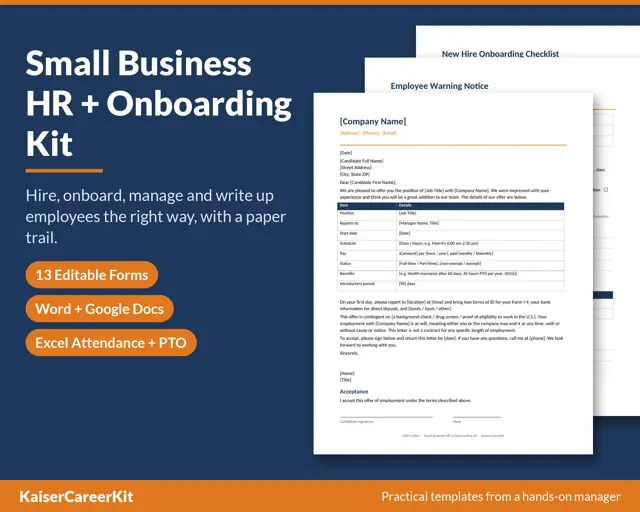
Employee Onboarding Checklist + Small Business HR Forms Kit
Hiring your first employees, or tired of making HR forms from scratch every time?
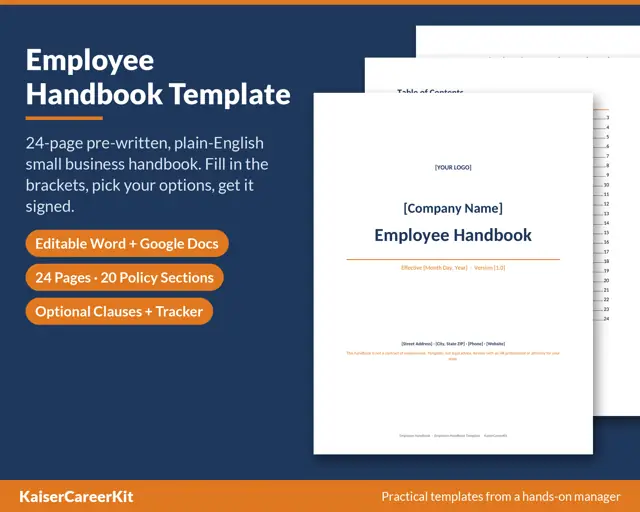
Employee Handbook Template
I've hired, trained and coached crews in a manufacturing shop, a hotel and a paint department.
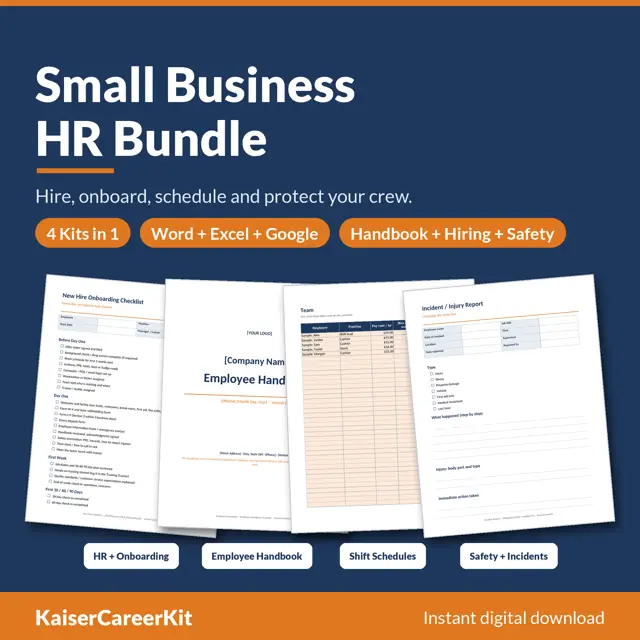
Small Business HR Bundle
A small business HR bundle with 4 complete template kits for owners and managers who are hiring, onboarding, scheduling and keeping a crew safe, from the first job post to an employee's last day.
Optional
Related books

The New Supervisor on the Shop Floor
A Practical Guide for First-Time Managers in Manufacturing, the Trades and Operations
More like this
Work and Hiring
How to Write an ATS-Friendly Resume
Write a resume that a person and an applicant-tracking system can both read: a simple layout, clear headings, and language taken from the job posting.
Work and Hiring
How to Onboard Your First Employees
A simple onboarding plan for a small shop: what to do before day one, on the first day, in the first week, and at 30 days, without a large HR department.
Free printable
Get the free Christmas word search
Print a sample of our holiday word search puzzles for family game night, the classroom, or a quiet evening with coffee. Big, easy-to-read puzzles.
Free download, no purchase needed. The checkout page may ask for an email address to deliver the file.